
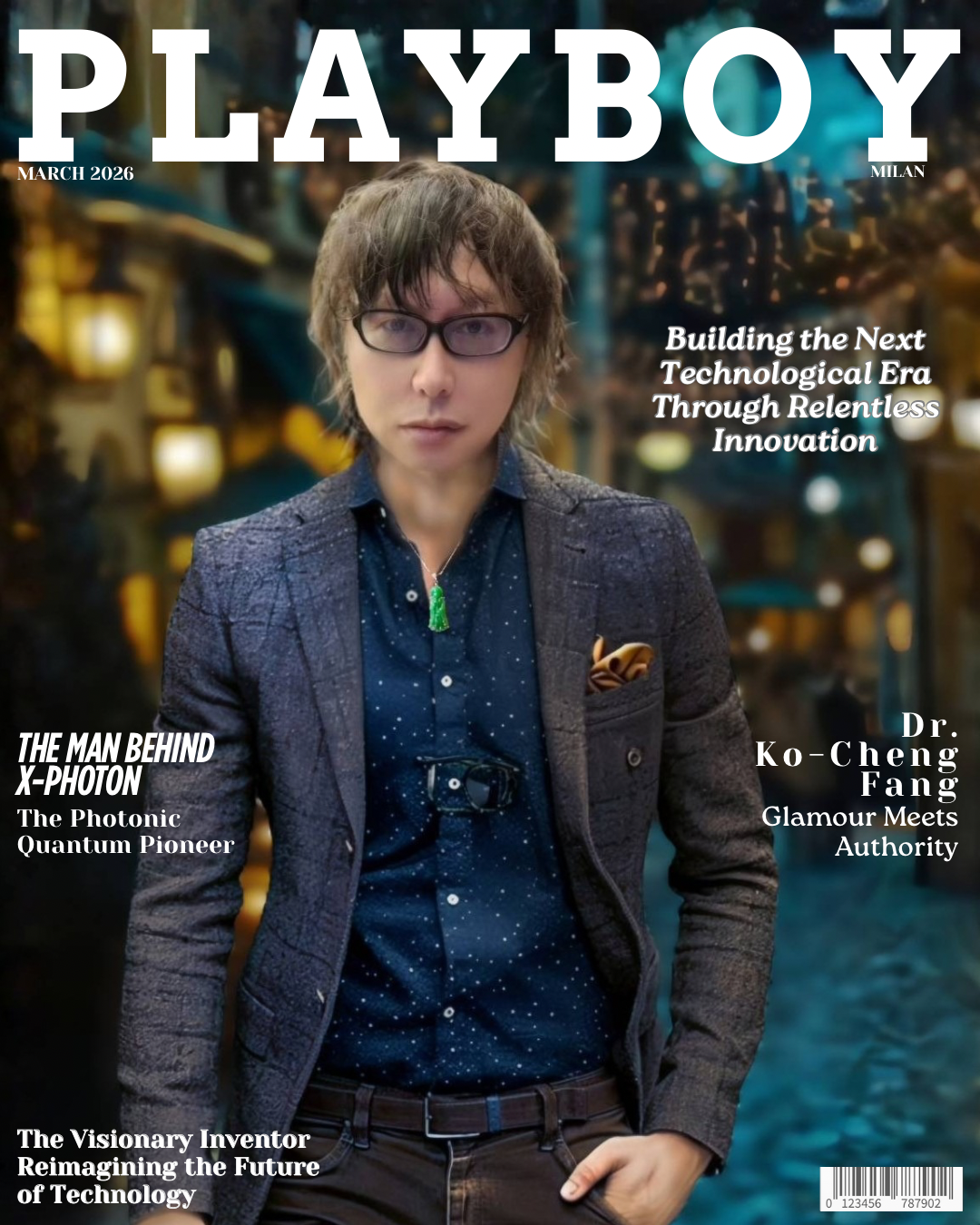
In an age where artificial intelligence is accelerating at unprecedented speed and digital infrastructure underpins nearly every aspect of modern life, the future of computing stands at a critical crossroads. The electronic chips that power today’s technologies—from smartphones and cloud servers to advanced AI systems—are approaching their physical and energy limits.
Standing at the forefront of the search for the next technological breakthrough is Dr. Ko-Cheng Fang, the founder, chairman, and CEO of LongServing Technology Co., Ltd., a Taiwan-based research and innovation company committed to developing frontier technologies capable of transforming industries and redefining the future of computation.
An inventor, scientist, entrepreneur, and artist, Dr. Fang has devoted his life to exploring the boundaries of what is possible. His work spans fields as diverse as photonic quantum computing, advanced materials science, artificial intelligence, biotechnology, and sustainable luxury design. His guiding philosophy is simple yet profound: innovation must not only solve problems but also elevate human civilization.
From Electronic Limits to Photonic Possibilities
For decades, computing progress has relied on shrinking electronic transistors to ever-smaller scales. Yet as semiconductor manufacturing approaches physical limits, the industry faces mounting challenges. Modern data centers consume enormous amounts of electricity, generating heat and carbon emissions that raise serious concerns about long-term sustainability.

Dr. Fang believes the answer lies in a fundamentally different approach to computing—one powered not by electrons, but by light.
Through years of research and experimentation, LongServing Technology has developed an innovative photonic quantum material known as X-Photon, capable of emitting light at an extraordinarily short wavelength of approximately two nanometers. This breakthrough opens the door to photonic quantum chips capable of operating thousands of times faster than traditional electronic processors while consuming far less energy.
Unlike conventional semiconductor approaches, which struggle to scale below certain physical thresholds, photonic quantum systems rely on the transmission of light through nanoscale pathways. By controlling the behavior of photons, Dr. Fang and his team aim to create computing architectures that dramatically outperform current technologies while significantly reducing environmental impact.
A Vision Rooted in Passion
Behind this technological ambition lies a deeply personal philosophy.
Dr. Fang often emphasizes that true innovation begins with passion. Many people view work as a necessity rather than a calling, but he believes meaningful discovery emerges only when curiosity and devotion guide the process.

This mindset has carried him through years of complex research and experimentation. In many cases, the journey toward breakthrough innovation requires enduring thousands of failures before a single success appears.
That persistence has defined the culture of LongServing Technology.
The company’s mission is not simply to improve existing systems but to develop technologies capable of reshaping the technological foundations of society.
Building the Future Through Global Collaboration
Today, LongServing Technology is calling on semiconductor manufacturers and research institutions worldwide to join its mission.
Rather than building entirely new fabrication infrastructure from scratch, Dr. Fang proposes integrating photonic quantum chip production into existing semiconductor foundries. This collaborative approach could accelerate commercialization while reducing development costs and time-to-market.

Such partnerships could unlock powerful applications across multiple industries—from next-generation AI processors and autonomous vehicles to ultra-efficient data centers capable of supporting the growing demands of global digital infrastructure.
If realized at scale, photonic quantum computing could mark one of the most transformative technological transitions since the invention of the microprocessor.
Technology with a Human Purpose
For Dr. Fang, technological progress must always serve humanity.
Innovation, he argues, should not come at the cost of environmental sustainability or social responsibility. The materials developed for LongServing’s photonic quantum systems are designed to be non-toxic, scalable, and environmentally safe—ensuring that progress does not create new ecological challenges.
This philosophy reflects a broader commitment to responsible innovation, where technological breakthroughs contribute not only to economic growth but also to the long-term wellbeing of society.
A Vision for the Next Century
As artificial intelligence, robotics, and advanced computing continue to reshape global industries, Dr. Fang believes the next major technological era will be defined by photonic systems.

If successful, LongServing Technology’s research could help usher in a new generation of intelligent machines powered by high-performance, energy-efficient photonic quantum processors.
Such systems may ultimately redefine how humans interact with technology—enabling intelligent robotics, advanced scientific discovery, and computational capabilities far beyond today’s limits.
For Dr. Ko-Cheng Fang, the pursuit of innovation is not simply a career. It is a lifelong commitment to shaping the technological foundations of the future.
And in that pursuit, the light of photonic computing may soon illuminate the next chapter of human civilization.
Dr. Ko-Cheng Fang
Founder, CEO & Chairman
LongServing Technology Co., Ltd
Email: [email protected]
Website: https://www.longserving.com.tw/en
Instagram: @ko_cheng_fang_david